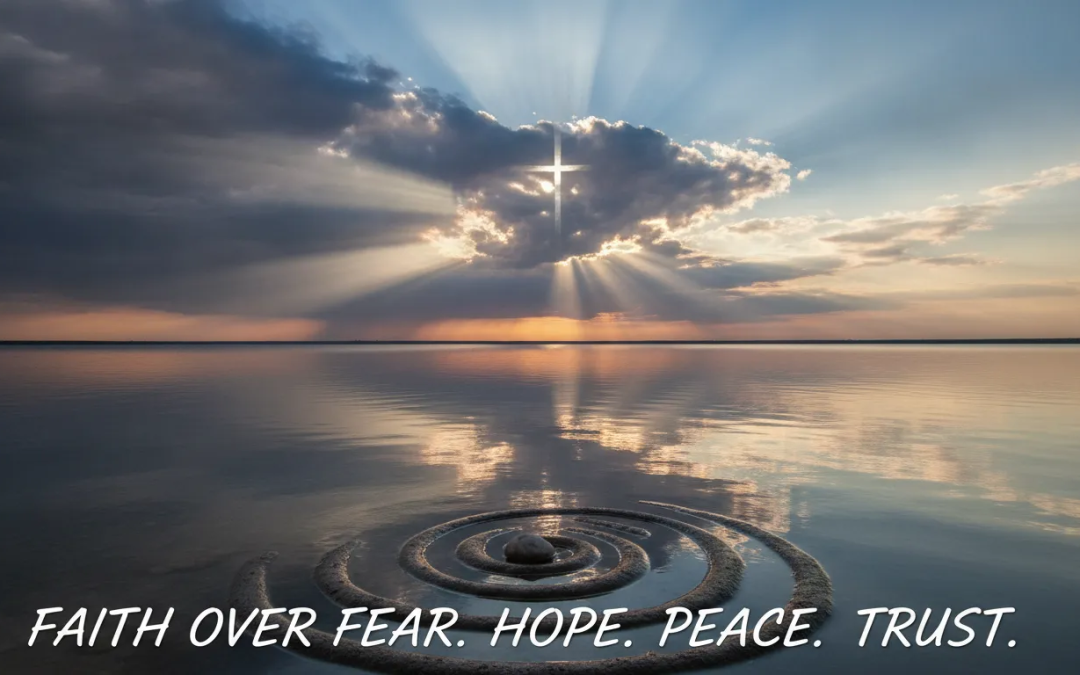
Waking up at three in the morning with a tight chest is a lonely kind of terror. You try to breathe, but your mind is already spinning with every worst-case scenario. This is where fear takes the wheel, whispering that you are completely on your own.
An active practice of faith over fear is the conscious decision to trust God’s warm, loving presence much more than you trust your own worried thoughts. While research in a National Institutes of Health study shows that spiritual practices can greatly lower daily anxiety, this healing shift is ultimately a deep and personal choice. Rather than trying to carry the heavy weight of control and worry on your own shoulders, you can choose to rely on a power that loves you unconditionally. By taking small, consistent steps to choose faith over fear, you open your heart to a steady, quiet peace that remains with you even when life feels uncertain.
But how do you make this choice when your heart is racing and worry takes over? To move forward, you must look past the popular slogans and understand what this path really asks of you. The path begins with exploring What Does “Faith Over Fear” Really Mean?
What Does “Faith Over Fear” Really Mean?
You have likely seen the phrase on t-shirts, bumper stickers, and coffee mugs. In our modern culture, “faith over fear” has become a popular slogan. But for many, this cheap version of faith feels hollow when real life gets hard.
Beyond the bumper stickers
The commercial version of this phrase suggests that if you have enough faith, you will never feel afraid. It implies that fear is a sign of weakness or a lack of spiritual strength. But this idea is not true and it can cause deep harm. Real faith does not mean the absence of fear.
In fact, fear is a natural human response to pain and the unknown. The ego uses fear to protect itself. Discarding the shallow t-shirt version allows you to choose faith over fear in a way that is honest, raw, and deep.
The choice to trust when you are scared
True faith is not a passive feeling. It is an active choice that you make when you feel afraid. Choosing faith means looking at your life, weighing your options, and seeing the danger. Then you make a choice to trust God anyway.
You do not have to wait for your fear to go away before you act. You can feel anxious and still trust in God at the same time. The Bible contains at least 365 verses that tell us to “fear not,” which is one for each day of the year. God repeats this command so often because He knows we will feel afraid.
Research published by the National Institutes of Health shows that deep spiritual faith can build mental strength and hope during hard times. When you lean on a higher power, you shift from trying to control everything on your own to trusting in God’s presence.
A spirit of power and a sound mind
Scripture offers a clear picture of what this shift looks like. In the book of Hebrews, faith is defined as the assurance of things hoped for, and the conviction of things not seen. It is a deep inner knowing that God is with you, even when you cannot see the path ahead.
Another key verse is 2 Timothy 1:7, which states that God has not given us a spirit of fear. Instead, He has given us a spirit of power, of love, and of a sound mind. This means that fear does not come from God. When anxiety grips your heart, you can claim the power and sound mind that God has already put inside you.
Choosing faith does not mean you ignore your problems. It means you choose to believe that God is bigger than those problems. It is a daily practice of letting go of control and letting God lead your steps.
What Fear Does to Your Soul
Fear is more than a feeling in your body or a thought in your mind. It is a spiritual block that shuts down your connection to God. When you live in fear, you build a wall between yourself and the Divine. This wall keeps you from feeling the peace and love that are always yours.
The ego using fear as a shield
Your ego does not want you to grow. It wants to keep you small and safe in what you know. Spiritual teaching shows that fear is a defense mechanism used to protect the ego from experiencing the oneness of God.
The ego uses fear to make you feel separate from God. Because of this, you try to control everything on your own instead of trusting a higher power. You lose your peace.
Why do I keep repeating the same painful patterns?
When fear rules your mind, you act only to survive. Living this way is hard. Your ego seeks safety by repeating old habits. That is why the same painful patterns keep showing up in your life. You stay in bad jobs or painful relationships because change feels too risky, even when you are miserable.
Science supports the idea that faith-based tools can break these cycles. A clinical study on spiritually based practices showed that they can lead to a major drop in daily anxiety. When you shift your focus from your own ego to a higher power, your mind begins to calm. This calm lets you make new, healthy choices.
How religious trauma keeps you stuck
For many of us, this fear was taught to us when we were young. It runs deep. If you grew up in a strict church, you may have learned to fear God instead of trusting Him. These old beliefs can make you feel unworthy. You might carry a deep sense of guilt that blocks your connection to the Divine.
Start your path to freedom by healing from guilt and shame so you can experience God’s true love. When you let go of these fear-based beliefs, you open your soul to real peace. You can choose a new path. This is how you begin to choose faith over fear in your daily life.
Fear vs. Faith: How Each Shapes Your Life
| Area of Life | Living in Fear | Living in Faith |
|---|---|---|
| Your identity | Defines you by your mistakes and flaws | Defines you as a beloved child of God |
| Your decisions | Driven by what might go wrong | Guided by trust in what God can do |
| Your relationships | Built on walls and self-protection | Built on openness and vulnerability |
| Your future | Dread of the unknown | Hope for what God is working in you |
| Your spiritual life | Rule-keeping to earn approval | Resting in God’s unconditional love |
What God Actually Says About Fear
When you look at ancient holy books, you find deep wisdom about how to live. These texts are not just for church rules or old laws. They are like a warm guide for your daily life, showing you how to choose faith over fear. Let us look at what God actually says about your fears. By looking at these words, you can learn to rest in His care.
A steady light in the dark
The words of Psalm 27:1 are a great place to start. It asks, “The Lord is my light and my salvation; whom shall I fear?” When life feels dark, God is like a bright lamp for your path. You do not have to walk through the shadows alone or rely only on your own strength. He is there to guide your steps and help you walk with a peaceful heart.
The book of Proverbs gives us another wise lesson about how fear can hold us back. It says that the fear of other people is a trap, but those who trust in God will be safe. So often, we get stuck trying to please others or worrying about what they think. God tells you that your worth is already safe with Him. You do not need to earn their praise to be loved by Him.
The choice to trust and surrender
In Psalm 56:3-4, the writer says, “When I am afraid. I put my trust in you.” This short verse shows us a vital truth about how we react to hard times. It is okay and normal to feel fear when life gets hard. God does not expect you to be a hero who never gets scared. But when fear comes, you can make the active choice of trusting God when life is hard. This choice is a daily practice that grows stronger with time.
Jesus shares a similar path to peace in the famous verse of John 14:27. He says, “Peace I leave with you; my peace I give to you.” This deep peace is not just about having an easy day. It is about knowing that God is with you in the middle of your storms. You do not have to carry the heavy weight of the world on your own shoulders.
Modern studies show that simple faith steps can help. Research published in the National Institutes of Health shows that a deep spiritual focus helps build hope and inner strength. When you stop trying to control everything, your mind can finally rest. Letting go allows God to lead you forward.
A spirit of love and power
One of the most famous verses about fear is 2 Timothy 1:7. This text tells us that a spirit of fear does not come from God. Instead, God gives us a spirit of power, love, and a sound mind. This means that fear does not come from the Divine. He wants you to feel safe, calm, and secure.
When you feel anxious, remember that God wants you to feel strong and loved. You can let go of the old guilt and worry. You can choose to live with a calm and clear mind, knowing you are held by love. You do not have to earn this deep love because it is already given to you.
5 Practical Ways to Choose Faith Over Fear Every Day
How do you move from anxiety to peace? Choosing faith over fear is not a single leap. It is a slow, daily walk. It is about trusting God in small moments.
Many of us grew up with fear-based teachings. We learned to fear God, fear the world, and even fear ourselves. But you can start choosing faith over fear in your daily life by changing how you react.
Your Daily Practice of Trust
Trust is not something you feel first. It is an active choice that you build over time through surrender. When you let go of control, you make room for peace. This shift is how you turn from self-reliance to God-reliance.
Choosing trust is like using a muscle. It gets stronger each time you use it. You do not need to be perfect to start. God meets you exactly where you are today.
- Name what you are actually afraid of. Bring your fears into the light. When you write them down in a journal, they lose their secret power over you.
- Speak truth to the fear. Use simple affirmations or sacred words to calm your mind. Replace the old thoughts with the truth of God’s love.
- Take one small trust action anyway. You do not need to feel brave. You just need to take one tiny step forward, knowing God is with you.
- Practice surrender through prayer or meditation. Start each morning by turning your worries over to a higher power. Let go of how things must turn out.
- Find a supportive spiritual community. Share your path with others who understand. We need each other to stay strong when doubts arise.
Telling Intuition from Fear
How do we know if we are hearing a warning from our soul or just old panic? Learning the art of telling intuition from fear is key to your peace. Fear is loud, fast, and full of dread. Intuition is quiet, still, and grounded in love.
Fear tells you that you are alone and in danger. It wants you to run or hide. On the other hand, your true inner guidance points you toward growth. When you feel a deep sense of calm beneath the storm, that is God guiding you.
The Power of Community
You do not have to carry the weight of worry on your own. Reaching out to others is a vital step in your healing. Studies in the National Institutes of Health show that spiritual practices and community help build deep mental strength during tough times.
Another clinical study in the National Library of Medicine found that faith-based groups help lower symptoms of generalized anxiety. When we share our stories, we realize we are not alone. You can heal from the old guilt and start to live in love.
Can Faith and Anxiety Coexist?
We often think that having a strong bond with God means we will never feel afraid. If you struggle with panic or worry, you might feel like your spiritual walk has failed, but this is not true. You do not have to be perfect to receive love. You might ask, can faith and anxiety coexist, and the short answer is yes.
The myth of perfect peace
Many seekers feel guilt when they cannot pray their worries away. You may feel still anxious after spiritual work because of weak trust, but this is a trap from the ego. True peace is not the absence of trouble, but the presence of God in the midst of it. Shifting your focus from self-reliance to God-reliance is how you choose faith over fear.
We are taught to think that any doubt means we lack faith. But having a personal walk with God does not mean your brain stops feeling stress. Even the most devout people can feel a deep sense of dread or panic. You do not have to be perfect to receive divine love.
How faith reshapes fear
Instead of fighting your anxiety, you can change how you hold it. Research on spirituality and wellness shows that deep faith leads to more hope, but you are not immune to daily worries. Faith is a muscle you build over time through small, daily acts of surrender to the divine. Even when you feel a wave of panic, you can still choose to turn to God and rest in that love.
To find peace, you must let go of the need to control, because God meets you where you are rather than demanding that you be perfect. You can use simple tools like silent prayer, writing, or deep breathing to calm your mind. Shifting from your own power to God’s power is the core of healing. By taking these small steps of trust, you allow God to carry the heavy loads you were never meant to bear on your own.
Finding peace in the storm
You do not have to walk this long path on your own. True healing begins when you stop hiding your deepest fear and bring it into the light. When you join a group, you see you are not alone in your struggle. As you release the weight of control, you will find that a quiet, lasting peace is always waiting for you.
Frequently Asked Questions
How do I trust God when my life is not going the way I hoped?
Trusting God is not a passive feeling but a daily, active choice. When the outer world looks hard, you can choose to surrender your need for control and trust that God is present within the struggle. Real peace does not mean your problems go away; instead, it is about finding the Divine in the midst of trouble. To help you practice this surrender, try choosing faith over fear in your daily life by taking small, steady steps of trust each day.
Why am I still anxious even though I have done so much spiritual work?
It is common to feel anxious even after years of spiritual practice. Anxiety often comes from deep-seated, fear-based beliefs that take time and steady focus to release. Yet, spiritual habits that focus on a loving bond with God rather than rigid rules can help you feel safe. In fact, a study in PubMed Central shows that multifaith, spiritual practices help reduce symptoms of generalized anxiety. Choosing faith is a daily choice, not a one-time event.
How do I overcome a fear of God after leaving religion?
Many people carry deep fear and guilt from rigid religious rules. To heal, you must first know that your own worth is not tied to church rules or deeds. God does not wait for you to be perfect before loving you. You can learn to choose faith over fear by shifting your focus from rigid duty to a warm, personal bond. True faith is built on love and trust, not on a fear of judgment.
How do I tell the difference between my intuition and fear?
Fear is a tool used by the ego to protect itself. It feels loud, fast, and anxious, often looping old, painful habits. Intuition is a quiet, steady nudge from your soul. It brings a deep sense of peace, even when it asks you to take a risk. Learning the art of telling intuition from fear asks you to slow down and listen to the quiet space in your heart.
Ready to choose faith over fear in your daily life?
If you wait to take action, fear and daily doubt will keep holding you back from the true peace God wants for you in your life. You can break this loop of spiritual blocks right now to start your path of deep healing without any of your old religious guilt or shame. Choosing trust today will help you honor your deep soul calling and live your life with a clear heart, clear mind, and real, lasting joy.
Ready to heal? You do not have to carry the weight of worry, control, and heavy duty on your own shoulders anymore. Please do not let fear run your life for another day. Book a Channeled Healing Session today to start choosing faith over fear and find your way back to God.